
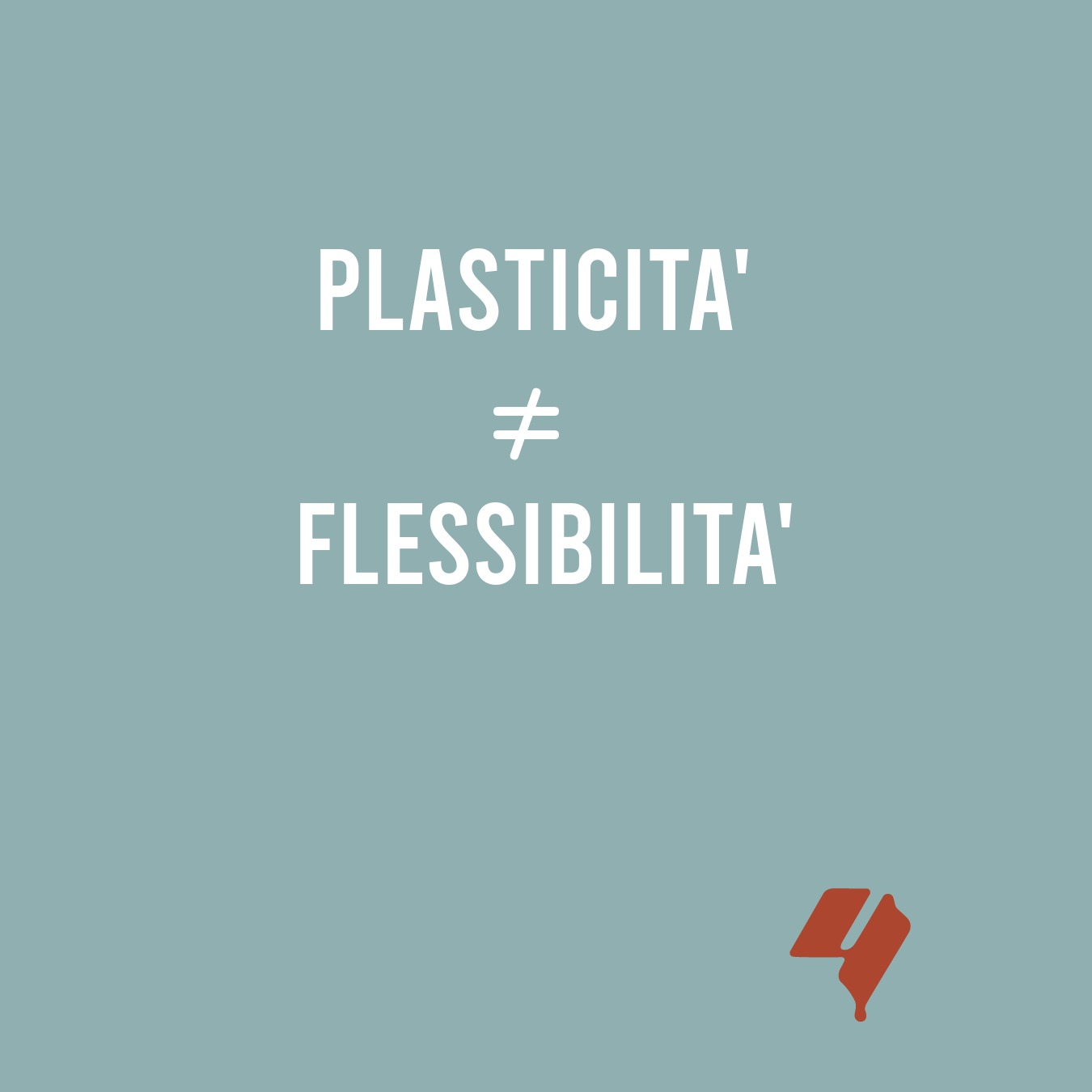
Platicity ≠ Flexibility
Il fenomeno della plasticità del cervello viene in realtà spesso descritto nei termini di una economia della flessibilità.
La plasticità si situa fra due termini: da un lato il prendere una forma (scolpire, modellare, dare forma a un materiale plastico); dall’altro, l’annullamento della forma (il plastico, la detonazione).
La plasticità del sé, che suppone una simultaneità nel ricevere e dare forma, implica la ricerca di equilibrio fra il mantenimento di una permanenza (il sé autobiografico) e l’esposizione di questa permanenza a ciò che è accidentale, esterno, all’alterità. Ne risulta una tensione nata dalla resistenza che permanenza e creazione oppongono una all’altra.
Ed è così che ogni forma porta con sé le sue stesse contraddizioni. Proprio questa resistenza rende possibile la trasformazione.
La capacità del soggetto di autocostituirsi non deve essere concepito come un semplice adattamento a una forma, o a uno schema culturale dato. Ognuno è formato solo per effetto della resistenza a prendere una forma.
La promessa del polimorfismo, aperto a tutte le forme, capace di indossare ogni maschera, ogni postura, tutte le attitudini, mette a rischio la costituzione di un’identità. Invece di rivelare la reale tensione fra permanenza ed evoluzione, la flessibilità confonde quei termini dentro una logica di pura imitazione e performance. Non è creativa ma riproduttiva e normativa.
Catherine Malabou, 2008
______
Platicity ≠ Flexibility
The phenomenon called “brain plasticity” is in reality more often described in terms of an economy of flexibility.
Plasticity is situated between two extremes: on one side the taking on of form (sculpture, molding, fashioning of plastic material); on the other, the annihilation of form (plastique, detonation).
The plasticity of the self, which supposes that it simultaneously receives and gives itself its own form, implies a necessary split and the search for an equilibrium between the preservation of constancy (the autobiographical self) and the exposure of this constancy to accidents, to the outside, to otherness.
What results is a tension born of the resistance that constancy and creation mutually oppose to each other.
And so it is that every form carries its own contradictions. It is precisely this resistance that makes transformation possible.
The subject’s capacity for self-constitution must not be conceived as a mere adaptation to a form or to a given cultural pattern. Each person is shaped solely by the effect of resisting the imposition of a form.
The promise of polymorphism—open to all forms, capable of wearing every mask, every posture, every attitude—jeopardizes the constitution of an identity. Instead of revealing the real tension between permanence and evolution, flexibility confuses those terms within a logic of pure imitation and performance. It is not creative but reproductive and normative.

 :
: